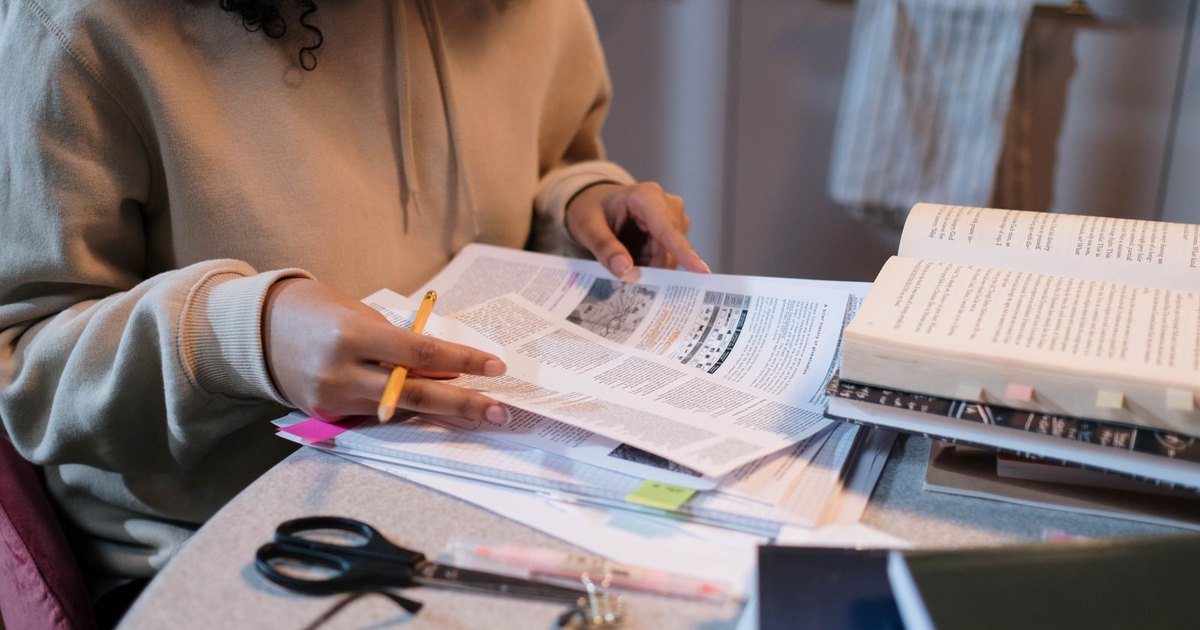
How do you organize your revision over 4 weeks?
By giving each week a precise role: the first to take stock, the second to fill the gaps, the third to practise in exam conditions, the fourth to consolidate without overloading. Revising is not rereading your notes: it is testing yourself, spotting what does not hold, then coming back to it several times.
This plan is for middle and high school students, and their parents. It fits any exam: adjust the number of hours to your real schedule rather than aiming for a programme you will not keep.
Before you start: three decisions
- The exam date and the subjects. Write them at the top of the page, with the weight of each subject.
- The hours available. Count those left after classes, meals, sleep and obligations. Be realistic.
- A fixed place and time. A quiet desk and a regular hour are worth more than a good resolution.
Week 1: take stock
- List, subject by subject, the chapters on the syllabus.
- For each chapter, rate your confidence from 1 to 3: I know it, half, I don't know.
- Take a quick test without notes: a few questions or an exercise. What you cannot redo is truly what to revise, whatever your impression.
- Rank the chapters: first the weakest AND the most important.
By the end of the week, you have a clear map of what to work on. Your marks over the year help show where your weaknesses are: if your school gives you access to your grades, look at the detail of each assessment, not only the average.
Week 2: fill the gaps
- Take the weak chapters one at a time, starting with the basics.
- Use active methods: redo exercises, explain out loud, write a summary sheet with the course closed.
- Ask for help with what you do not understand: a teacher, a classmate who has mastered it.
- Keep an error notebook: each mistake, its cause and the right method.
Week 3: practise as on exam day
- Do papers from previous years, timer in hand, without notes.
- Then correct carefully: see whether the mistake comes from knowledge, method, time or reading the question.
- Alternate subjects through the week rather than doing everything in one block.
- Redo the missed exercises three or four days later.
Week 4: consolidate and get ready
- Reread the summary sheets and the error notebook, without starting big new chapters.
- Shorten the sessions and keep the regularity.
- Prepare the logistics: call-up letter, venue, equipment, journey, ID if required.
- The night before, revise lightly and sleep.
A typical revision day
| Moment | Activity | Indicative length |
|---|---|---|
| Start of session | Recall what was covered yesterday, without notes | 10 minutes |
| Block 1 | Weak chapter: exercises, summary sheet | 40 to 50 minutes |
| Break | Walk, drink, no screen | 10 minutes |
| Block 2 | Another subject: exercises or a past paper | 40 to 50 minutes |
| End of session | Note the mistakes and tomorrow's task | 5 minutes |
These lengths are indicative: adjust them to your concentration, not to a template.
Mistakes that cost dearly
- Rereading without testing yourself. Rereading gives an impression of mastery, but not mastery.
- Leaving everything to the last week. The brain retains better with spaced revision.
- Revising only what you like. The weakest area is the one that earns the most points.
- Sacrificing sleep. A short night before an exam costs more than it brings.
- Keeping the phone within reach. Put it away during work blocks.
For parents: how to help
Help set the schedule, protect the time and place of work, and ask questions about what the student is learning. Do not add pressure: ask "what did you revise today?" rather than "have you finished?". For everyday homework, see our article on homework help.
Frequently asked questions
How many hours a day should I revise?
It depends on the student, the exam and the schedule. Two focused work blocks kept every day beat six irregular hours.
Should I revise every day, Sunday included?
Keep at least half a day of rest per week: rest is part of the plan.
What if I start less than four weeks before the exam?
Keep the structure but shrink it: take stock in a day or two, focus on the weakest and most important chapters, and keep time to practise on papers.
Where can I see my marks and timetable in ClassMata?
If your school uses ClassMata, the student space groups My Grades, My Bulletin and My Timetable, read-only.
Last updated: . Lire cet article en français.